
Sound Films A
Marlene Dietrich
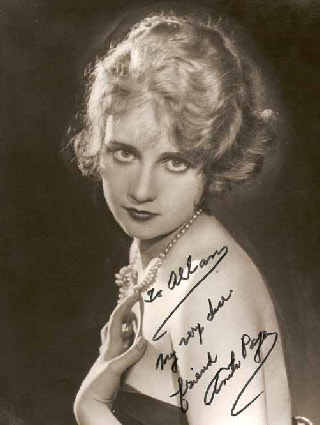
Anita Page
NEW SPECIAL NO FRILLS OFFER – NO ARTWORK OR CASES, SHIPPED IN PAPER SLEEVES. 3 FILMS FOR £20.00, 5 FILMS FOR £30.00 OR 10 FILMS FOR £50.00 AND NO ADDITIONAL POSTAGE CHARGES ANYWHERE IN THE WORLD!! NEW
NEW HAVE YOUR FILMS DELIVERED BY FILE TRANSFER DIRECTLY TO YOUR HOME COMPUTER FOR JUST £5.00 PER TITLE NEW
1002nd Night, The (1933)
Directed by Alexandre Volkoff and starring Ivan Mozzhukhin, Tania Fedor and Nita Alvarez, this is a French film dubbed in English with a runtime of 65 mins. Unfortunately the print quality is below par. One for the dedicated collector of Mozzhkhin….£7.49
24 Hours (1932)
starring Miriam Hopkins and Kay Francis. Adulterous couple Clive Brook (his stiff,
inebriated self) and Kay Francis (captivating here in one of her subtle, effective
performances)survive an harrowing 24 Hours in which Brooks' lover (Miriam Hopkins
steals the show as a lively chanteuse) manages to get bumped off by her maniacal
husband (Regis Toomey). It's tastefully handled, yet gripping in its understatement.
The photography is fluid -
42nd Street (1933)
Starring Warner Baxter, Bebe Daniels and Ruby Keeler……£7.49
A Nous La Liberte (1931)
Directed by Rene Clair, this film has a runtime of 83 mins…..£7.49
Abe Lincoln in Illinois aka Spirit of the People (1940)
Starring Raymond Massey and Gene Lockhart…..£7.49
Abilene Town (1946)
Starring Randolph Scott and Rhonda Fleming……£7.49
Abraham Lincoln (1930)
Directed by DW Griffith and starring Walter Houston. Brief vignettes about Lincoln's
early life include his birth, early jobs, (unsubstantiated) affair with Ann Rutledge,
courtship of Mary Todd, and the Lincoln-
Ace Drummond (1936)
"Ace Drummond" is a 13 Chapter serial based on the popular comic strip of the day written by U.S. WW1 ace Eddie Rickenbacker. The story takes place in Mongolia where International Airlines is attempting to establish a link to the orient. A criminal mastermind known as "The Dragon" is attempting to stop the airline. It seems that an archaeologist, Dr. Trainor (Montague Shaw) has discovered a mountain rich in jade and "The Dragon" feels that an international presence would foil his desire to gain control of the treasure….£7.99
Adventures of Baron Munchausen, The (1943)
Directed by Josef von Baky and starring Hans Albers, Wilhelm Bendow and Brigitte Korney this film has a runtime of 111 mins and the print quality is very good to excellent.
Plot: This lavish, impudent, adult fairy tale takes the viewer from 18th-
Review: Baron Karl Friedrich Hieronymus von Munchhausen was a historic German nobleman,
who became famous for throwing lavish parties at his home in Bodenwerder, where he
told the most fantastic tall tales about his adventures. Now a well-
Extremely funny and hilariously
entertaining, Josef von Baky created an unusual and highly original odyssey through
Europe, of a man pursuing the exciting and adventurous. Those who have read the stories,
know that some of Munchhausen's more famous deeds include his ride on the cannonball,
tying his horse to the tip of a church tower and breaking into the ice, out of which
he pulls himself by his own hairs. The first one mentioned can be found in the movie,
as well as other humorous scenes, that perfectly fit into the Munchausen concept.
Munchhausen lived at the end of the 18th century in Brunswick, but he always traveled
around Europe with his loyal servant Christian Kuchenreuter. The story starts out
with Munchhausen returning from one of his several trips to his residence in Bodenwerder,
where all the jackets in his cabinet get rabies and Christian introduces a fascinating
substance, that makes a man's beard grow in a matter of seconds. Hours later, Munchausen
leaves for the court of Prince Anton Ulrich of Brunswick, who is commanded to leave
for St. Petersburg, and would like Munchhausen to accompany him. On their way to
Russia, Munchhausen and Christian encounter the dark Count Cagliostro, who is wanted
all over Europe for performing notorious witchcraft. He plainly tells Munchhausen
of his intentions to become count of the Courland, and asks Munchhausen to assist
him, which he denies, by telling him that he has absolutely no intention of reigning.
In St. Petersburg, he meets Katharina the Great and the two become lovers, and he
also meets Cagliostro again, and warns him that Katharina intends to arrest him.
Out of gratitude, Cagliostro gives Munchausen a ring that makes him invisible and
the ultimate gift of eternal youth, as long as Munchhausen wants it.
Baron Munchhausen
was never very complex in the original stories, as they mostly focused on his fairy
tales, rather than the vast and interesting personality. But here, the man is a very
deep and powerful character, who sees people die around him, while he possesses the
gift of eternal life, and becomes more and more torn between his desire for adventure
and that to share a mortal life with his friends and loved ones. For this movie the
basic concept of the Munchhausen stories was changed a bit, with the film being somewhat
of a life story, even though there is no real linear plot, with the narrative reminding
more of episodes. While a lot of the film is actually more of a historical drama
than fantasy, many scenes will bring you into the wonderful world of Baron Munchhausen,
including the cream that makes your hair grow in a matter of seconds, the rifle that
can shoot accurately for hundreds of miles and the ride to the moon in an air balloon.
An exemplary tale of imagination and creative adventures, Munchhausen's visual effects
can't measure up the ones of today, of course, but in perspective to the times, they
are absolutely stunning.
Some of the acting in this movie really stands out, even
though it mostly centers around the colorful sets. Hans Albers makes the perfect
Baron Munchhausen, a witty, intelligent, charismatic and very deep character, who
is not the perfect hero, but a man who goes through life trying to have it as exciting
as possible. Whether he's deeply philosophical, in the middle of one of his fun adventures,
or once again seducing a beautiful woman, Albers is extremely convincing as the flawed,
but good-
Another thing that might shock you is the nudity
in this movie, that wouldn't get past any US-
What's left to say, is that "Munchhausen" is a beautiful
tale of adventures and imagination, that is an impressive document of what Germany's
film industry was able to conjure in the 1940s already. And when Hans Albers rides
on the cannon ball, turns his head to the audience, and takes off his hat in greeting,
you will completely be captured by his charismatic and smart personality that brings
the magic to this outstanding movie…..£7.49
Adventures of Robinson Crusoe, The (1964)
The legendary TV series starring Robert Hoffman……£7.49
Adventures of Sherlock Holmes, The (1939)
Starring Basil Rathbone and Nigel Bruce……£7.49
Africa Screams (1949)
Starring Bud Abbott and Lou Costello……£7.49
Aimless Bullet aka Obaltan (1961)
Directed by Yu Hyun-
A couple years after the Korean war, Seoul has only begun to be rebuilt. The first
parts of the city reconstructed are for the few wealthy while the majority of the
people make do in their squatter huts. The hardships and anxieties of the social
and economic devastation are played out by a few people trying to better themselves
and those just trying to get by. Hopelessness and chronic unemployment lead to alternative
attempts at income and normalcy which trigger a downward spiral.
Review: It was banned
in Korea because it was so realistically stark in it's post war depiction. It was
similar to and inspired by Italy's "The Bicycle Thief," but not as good. The film
was pretty dark so the titles showed up even better. You could see that the locations
were real because of the adaptations people had made in their shanties were so numerous
& functional. The disparity between the barely haves & have nots was a source of
conflict shown by the rubble which also representative of the human spirit. The cinematographic
efforts were clearly present, but it was obvious there wasn't much experience with
the tools of the trade on hand. The individual character development was complete
in that the many problems exemplified by the individuals seemed to be a basic part
of their make up, and it was the subtext to their every action. The pacing felt a
bit slow at times, and the direction seemed to be trying to copy the film's predecessor
rather than break wholly new ground. This film was certainly ground breaking in Korea;
that is of course why it was banned. The many actors became their characters and
successfully showed their struggles as individuals with their own ways of coping.
Unfortunately,
this is not on video, and is a very rare find in the States even though it is such
an important work….£7.49
Alexander Nevsky (1938)
Directed by Sergei Eisenstein the film has a runtime of 108 mins…..£7.49
Alf’s Button Afloat (1938)
Excellent Crazy Gang Comedy…..£7.49
Algiers (1938)
Starring Charles Boyer and Hedy Lamar. Beautiful Gaby meets a romantic jewel thief in the mysterious Casbah. Pepe Le Moko, a thief who escaped from France with a fortune in jewels, has for two years lived in, and virtually ruled, the mazelike, impenetrable Casbah, "native quarter" of Algiers. A French official insists that he be captured, but sly Inspector Slimane knows he need only bide his time. The suave Pepe increasingly regards his stronghold as also his prison, especially when he meets beautiful Parisian visitor Gaby, who reminds him of the boulevards to which he dare not return...and arouses the mad jealousy of Ines, his Algerian mistress....£7.49
Alibi (1929) **UPGRADE – Improved print**
Directed by Roland West and starring Chester Morris, Mae Busch, Harry Stubbs, Eleanor Griffith, Irma Harrison, Regis Toomey, Pat O’Malley, Dewitt Jennings and Ed Brady, this film has a runtime of 82 mins and the print quality is very good to excellent.
Plot: Chick Williams, a prohibition gangster, rejoins his mob soon after being released from prison. When a policeman is murdered during a robbery, he falls under suspicion. The gangster took Joan, a policeman's daughter, to the theater, sneaked out during the intermission to commit the crime, then used her to support his alibi. The detective squad employs its most sophisticated and barbaric techniques, including planting an undercover agent in the gang, to bring him to justice.
Review: The story here is interesting enough and on its own ensures that no one will
feel disappointed at having watched this. Chick Weaver is a gangster just released
from prison who hooks up with a "copper's daughter." Unfortunately, he can't go straight
and gets involved with a warehouse robbery during which he kills a cop. The rest
of the movie essentially deals with his attempts to frame an alibi for himself and
with the efforts of the police to find the cop-
In that sense, I almost saw this serving as
a proverbial "missing link" between the silent era and the sound era. There are parts
of this movie which are very much like a silent movie -
This is an
enjoyable enough movie, and an interesting look at this transitional era of movie-
Alice In Wonderland (1933)
Starring Cary Grant, Edward Everett Horton and Many Others……£7.49
All About Eve (1950)
Starring Bette Davis……£7.49
All I Desire (1953)
Starring Barbara Stanwyck and Richard Carlson……£7.49
Aloma of the South Seas (1941)
Directed by Alfred Santell and starring Dorothy Lamour, Jon Hall, Lynne Overman, Phillip Reed and Katharine DeMille, this film has a runtime of 74 mins and the print quality is good.
Plot: A young South Seas native boy is sent to the U.S. for his education, returns to his island after his father dies to try to stop a revolution.
Review: ALOMA OF THE SOUTH SEAS is typical of a series of pictures made by Paramount
Studios during the late '30s and early '40s, set on some far-
Escape from reality is right, because these movies were as far
removed from reality as the Oort Cloud is from the Earth. But they were popular enough
to make the unpretentious Miss Lamour one of the most bankable stars in Hollywood
at the time. In fact, she is the main reason I purchased a copy of this film from
an online source, though more for its historical value than for any erudition one
might expect. As a movie collector, I wanted to have at least one Dorothy Lamour
sarong picture in which she was not accompanied by Crosby and Hope and this -
Not that it is a good movie.
It isn't but, to be enjoyed at all, it must be viewed within the context of its time.
The plot is almost non-
Dorothy Lamour does well enough in her lightweight role as the island maiden,
but Jon Hall is too beefy to pass for the virile Polynesian native chieftain in a
skimpy wrap-
Yet, even left as is, ALOMA could have benefited immeasurably
from actual outdoor locations, as did the silent 1926 version which was shot in Puerto
Rico and Bermuda. By confining filming to a sound stage, Paramount left us with a
claustrophobic effect that looks more like the interior of a lush greenhouse than
sultry island.
In her memoir, "My Side of the Road," Dorothy Lamour recalled, with
some amusement, a harrowing experience while filming ALOMA. "During the volcanic
explosion, I was supposed to swing across a gorge from one ledge to another but I
didn't push off hard enough and was short of my target. Then, as I swung back, I
couldn't reach the other ledge either. The crew urged me to let go the vine and jump
but it looked like too far a drop so I clung on for dear life. As I struggled to
stay on, I could feel my sarong slowly unravel until it finally slipped off. Everyone
was laughing but I hung on until I was rescued." The scene was reshot with Lamour
clinging to Jon Hall.
ALOMA OF THE SOUTH SEAS is a movie that can be enjoyed, but
only if viewed as a diversion; otherwise, it will seem antiquated and silly....£7.49
Amateur Gentleman, The (1936)
Starring Douglas Fairbanks Jr and Elissa Landi…..£7.49
Amazing Adventure (1937)
aka: The Amazing Quest of Ernest Bliss. The only British film Cary Grant made in the '30s Ernest Bliss is a rich young man with too little to do. Not realizing the depression he's in is due to boredom, Ernest consults a doctor. Sir James Aldroyd gives Ernest a prescription that he doesn't think Ernest can fill: Ernest must earn his own living for one year using none of his current wealth. Ernest bets him 50,000 English pounds that he can. £7.49
Amazing Mrs Holliday, The (1943)
Directed by Jean Renoir and starring Deanna Durbin and Edmond O'Brien, the film has a runtime of 93 mins…..£7.49
Amazing Transparent Man (1960)
Directed by Edgar G.Ulmer……£7.49
American, Soldier, The (1970)
Directed by Rainer Werner Fassbinder, who also stars alongside Karl Scheydt, Elga Sorbass, Irm Hermann and Margarethe Von Trotta. This film has a runtime of 77 mins and the print quality is excellent. This is a German language film with English subtitles.
Plot: Ricky is a cold-
Review: This is an early Fassbinder film, and from what I've seen, one of the best
of his first 11 (which make up his first stage as a filmmaker). It's Fassbinder in
gangster mode, and has been called an homage to film noir or even a parody of film
noir. This isn't the case though. The movie is just film noir done by Fassbinder.
There are little homages here and there, the beginning and end could be seen as being
inspired by Breathless (taken to ridiculous extremes), and there are lots of filmmakers
names used as characters, but Fassbinder isn't winking at the camera so much as just
being himself, which back then, could be quite bizarre. In fact, this might be one
of Fassbinder's most bizarre movies.
The camera stands still, characters occasionally
deliver seemingly unrelated monologues, unusual plot lines are treated nonchalantly
(Ricky's brother is in love with him?), people about to be killed don't seem to be
worried, and the singlehandedly greatest song ever plays over and over again, crooning
"so much tenderness is in my head, so much loneliness in my bed." To have this song
play over scenes of a stone-
The recent release
of this film on DVD should help bring it some attention, as its now available for
a pretty reasonable price from Wellspring. If you're looking for one of Fassbinder's
more mature, professional, socially poignant melodramas, maybe this isn't the movie
for you. If you're interested in an extremely unique unclassifiable early Fassbinder,
by all means, check this out. Despite the occasional nods to past filmmakers, it's
surprising how unique Fassbinder was from the start.
(for those who are Jim Jarmusch
fans, it's apparent films like these must have inspired the detached humor in some
of his more recent films)….£7.49
Angel On My Shoulder (1946)
Starring Paul Muni……£7.49
Angels With Dirty Faces (1938)
Starring James Cagney……£7.49
Anna Christie (1930)**UPGRADE**
Directed by Carence Brown and starring Greta Garbo, Charles Bickford and Marie Dressler this film has a runtime of 86 mins and the print quality is excellent.
Storyline: In New York, the alcoholic skipper of a coal barge Chris Christofferson receives a letter from his estranged twenty year old daughter Anna "Christie" Christofferson telling that she will leave Minnesota to stay with him. Chris left Anna fifteen years ago to the countryside to be raised by relatives in a farm in St. Paul and he has never visited his daughter. Anna Christie arrives and she is a wounded woman with a hidden dishonorable past since she had worked for two years in a brothel to survive. She moves to the barge to live with her father and one night, Chris rescues the sailor Matt and two other fainted sailors from the sea. Soon Anna and Matt fall in love with each other and Anna has the best days of her life. But when Matt proposes to marry her, she is reluctant and also haunted by her past. Matt insists and Anna opens her heart to Matt and to her father disclosing the darks secrets of her past.
Review: This early sound era adaptation of O'Neill's "Anna Christie" would be a decent
movie worth seeing on its own, but it is Greta Garbo that makes it particularly worthwhile.
The rest of the production is solid, and for the most part, its limitations are common
to many other sound movies made in 1930. Garbo herself rises well above the level
of the rest of the production, and Marie Dressler is also memorable and effective
in her smaller role.
It's easy enough to see why a story like this was chosen for
Garbo's first "talking" role. It provides a female central character who offers a
ready-
Animal Crackers (1930)
Starring the Four Marx Brothers. Captain Spaulding, the noted explorer, returns from Africa and attends a gala party held by Mrs. Rittenhouse. A painting displayed at that party is stolen, and the Marx's help recover it. Well, maybe 'help' isn't quite the word I was looking for, this is the Marx Brothers after all... £7.49
Anna Karenina (1935)
Directed by Clarence Brown and based on the Leo Tolstoy novel, this film boasts a stellat cast including Greta Garbo, Fredric March, Freddie Bartholomew, Maureen O’Sullivan, May Robson, Basil Rathbone, Reginald Owen and Reginald Denny. The runtime is 89mins and the print quality is very good.
Plot: This version of the Tolstoy classic lingers longer in Moscow during the weeks
that follow the initial meeting of the starstruck lovers-
Review: In Imperial Russia, the aristocratic Anna Karenina (Greta Garbo) travels
from Saint Petersburg to Moscow to visit her brother Stiva (Reginald Owen) and she
meets the cavalry officer Vronsky (Fredric March), who came with Stiva to the train
station to welcome his mother.
After a family reunion where Anna Karenina has a conversation
with her sister-
However Vronsky follows her and she introduces him
to her husband Karenin (Basil Rathbone) at the train station. Vronsky woos her and
soon they have a doomed love affair that will lead Anna Karenina to a tragic fate.
"Anna
Karenina" (1935) is the first and the unforgettable version of Tolstoy's classic
romance. Greta Garbor is perfect in the role of Anna Karenina, a beautiful and aristocratic
married woman that falls in love with a man in a society repressive with the women's
rights and feelings. The scene where her face appears in a cloud of steam is one
of the most beautiful of the cinema history.
The grandiosity and the camera work
of the initial scene showing the officer's table and the ball are still very impressive.
The heartbreak conclusion of a woman destroyed by her love is very sad. My vote is
eight.….£7.49
Anna Karenina (1948)
Directed by Julien Duvivier and starring Vivien Leigh, Ralph Richardson, Kieron Moore and Hugh Dempster, this film has a runtime of 112 mins and the print quality is very good to excellent.
Plot: Stefan and Dolly Oblonsky have had a little spat and Stefan has asked his sister, Anna Karenina, to come down to Moscow to help mend the rift. Anna's companion on the train from St. Petersburg is Countess Vronsky who is met at the Moscow station by her son. Col. Vronsky looks very dashing in his uniform and it's love at first sight when he looks at Anna and their eyes meet. Back in St. Petersburg they keep running into each other at parties. Since she has a husband and small son, they must be very discreet if they are going to see each other alone.
Review: When Vivien Leigh did her version of Anna Karenina for the British cinema
she had the advantage of a less stringent censorship in the UK than Greta Garbo had
working for MGM in the Thirties. Garbo was hemmed in by restrictions that she had
to be a wronged woman, seduced and abandoned by her lover, and committing suicide
to also atone for her sins.
Vivien plays a woman who knows precisely what she was
doing and yet she chose to flout the male dominated society of 19th Century Russia.
Like Garbo she is married to a pill of a husband and when a dashing young cavalry
officer shows his attentions to her, she falls madly in love.
It's pointed out to
her at least once in the film that her biggest sin is a lack of discretion. But Vivien
and Kieron Moore want the whole world to know what's going on with them. Like William
Randolph Hearst and Marion Davies.
MGM softened the portrait of Count Vronsky in the
Garbo version by making it an eagerness to get back into the military during war
that causes the breakup. Here Kieron Moore is far less noble. Not a bad person but
a weak one. His mother wants him to make a more advantageous marriage and not to
a woman with a bad reputation even though he's the one who gave her the bad reputation.
There's
also a cop out scene filmed by MGM where Vronsky played by Fredric March expresses
remorse over Anna in the end. No such scene exists in this more realistic version.
Of
course Ralph Richardson as the husband Karenin is just as big a pill as Basil Rathbone
was back in 1935. A man quite full of himself in his high level job in the Czar's
government, he only sees how Anna's betrayal is affecting him. Richardson is almost
doing a dress rehearsal for his portrayal of Dr. Sloper in next year's The Heiress.
Vivien
Leigh was unfairly compared to Greta Garbo back when this came out, unfairly I think
because there's only one Garbo. Vivien was a frail creature in life and that helped
in a lot of her work. Anna was a frail creature herself unable to stand up to the
hypocrisy and the pressure of the society around her.
In fact Anna Karenina is a story
of failure. Two people fall in love, one of them trapped in a loveless marriage,
and attempt to flout society and they lose. Tolstoy sees all that and records it
well, but offers no solution.
Women's liberation was off the radar in old mother
Russia.…£7.49
Anne Marie (1936)
Directed by Raymond Bernard and starring Annabella this is an excellent print of the film with a runtime of 98 mins…..£7.49
Anthony Adverse (1936)
Starring Fredric March and Olivia De Havilland……£7.49
Apache Rifles (1964)
Starring Audie Murphy……£7.49
Ape, The (1940)
Starring Boris Karloff……£7.49
The Ape Man (1947)
Starring Bela Lugosi.Conducting weird scientific experiments, crazed Dr. James Brewster,
aided by his colleague Dr. Randall, has managed to transform himself into a hairy,
stooped-
Applause (1929)
This is an early sound film starring Helen Morgan…..£7.49
Arizona Kid, The (1930)
Directed by Alfred Santell and starring Warner Baxter, Carole Lombard, Theodore Von Eltz and Wilfred Lucas, this film has a runtime of 86 mins and although the print quality is only OK it is an opportunity to see this Lombard rarity.
Plot: The Arizona Kid (Warner Baxter) carries out his mission as a Robin Hood-
Review: Warner Baxter does a bang up job as the Arizona Kid. The facial and vocal characteristics are charming and spot on all the time. He portrays a criminal with a heart. And there is many a twist in this tale of love. The character actors that come in and out of scenes briefly are all great. There are some great location shots and an authentic stage coach that helps introduce our main character in the beginning and is a vital link to the outcome of the film. The scenes are varied and short, so the pace of the film is good, but enough time is taken in the scenes between the Arizona Kid and Virginia (Carole Lombard) to allow us to believe they are falling in love. Unfortunately, Carole Lombard's acting is at its worst in this film. Her lines are delivered as if she was staring in a grade school play. However, the film keeps up ones interest and Carole plays quite a different part than is her norm, so it is well worth a viewing….£7.49
Arrowsmith (1931) **UPGRADE – Longer, improved print**
Directed by John Ford and starring Ronald Colman, Helen Hayes, Richard Bennett and Myrna Loy, this film has a runtime of 99 mins and the print quality is excellent..
Plot: Dr. Martin Arrowsmith aspires to become a medical research scientist. When
he impulsively marries nurse Leora Tozer, he instead decides to open a country medical
practice in South Dakota to support his wife better than he could as a laboratory
assistant. After a few years of working in his medical practice, Arrowsmith believes
that his intuitions are not that well-
Review: The fact that an idealistic medical doctor was the protagonist in Arrowsmith
is the reason why John Ford must have been attracted to this story and agreed to
film it for Sam Goldwyn.
Allegedly it was not a happy collaboration. Two very individualistic
men wanted to have their imprimatur on the film. They never worked together on a
finished product again, though Ford did start filming The Adventures of Marco Polo
for Goldwyn and quit.
I read the novel way back in the day when I was in high school
and we only get the second half of it. There's a great deal in the book before Ronald
Colman as Martin Arrowsmith goes to work for the Research Foundation and A.E. Anson
as Max Gottlieb. You miss quite a lot of the character development of Arrowsmith.
Of
course the plot mostly centers on Colman and his other mentor, Richard Bennett going
to a Caribbean Island where there has been an outbreak of plague. Along for the trip
is Helen Hayes who is Colman's wife Leora.
Colman is there to test a new serum and
he's under orders as a researcher to only administer the real stuff to half his patient
and a placebo to the others as a control group. This is where the racism of the time
kicks in as these human guinea pigs are black, probably the descendants of runaway
slaves. There is a black doctor named Marchand in the cast played by Oliver Brooks
and it is a rarity among black performers at the time in that the role was hardly
servile at all. Brooks seems to go along with the controlled experiment, but he becomes
one of many in the cast to meet a tragic end.
With some of what came out about the
Tuskegee experiments later on Arrowsmith may have been quite on target without knowing
it. A harrowing thought.
Colman and Hayes are an attractive pair of leads. Myrna Loy
has a much abbreviated role in the film as a New York socialite that Colman meets
down in the islands. In the book he has an affair with her and marries her later
on. You won't see that here.
Arrowsmith is a good film though I wish more of Lewis's
story got into the final product. But it probably would have run for three hours
and films just didn't do that back then….£7.49
As You Desire Me (1932)
Directed by George Fitzmaurice and starring Greta Garbo, Melvyn Douglas, Erich Von Stroheim, Owen Moore and Hedda Hopper, this film has a runtime of 70 mins and the print quality is very good to excellent.
Plot: Budapest bar entertainer Zara is a discontented alcoholic who is pursued by many men but lives with novelist Carl Salter. A strange man (Tony) shows up on Salter's estate claiming that Zara is actually Maria, the wife of his close friend Bruno. Maria, Tony claims, had her memory destroyed during a World War I invasion ten years ago. Zara doesn't remember but leaves with Tony to Salter's dismay. Bruno, now an officer in the Italian army, tries to coax Maria's memory back on his large estate. No one is really sure if Zara is Maria, and when Salter shows up with a mental case that he claims is the real Maria, everyone on Bruno's estate is desperately searching for the truth.
Review: This story is a quite close call on the famous case of Grand Duchess Anastasia
Nikolaevna, whose possible survival as well as claimants had been quite a few. Thank
God that at those times the technology wasn't advanced, so the romance and mystery
prevailed. Now of course the actual grave of the ill-
As You Like It (1936)
Starring Laurence Olivier……£7.49
As Young As You Feel (1951)
Starring Monty Wooley and Marilyn Monroe……£7.49
Ashes and Diamonds aka Popiól I Diament (1958)
Directed by Andrzej Wajda and starring Zbigniew Cybulski, Ewa Krzyzewska, Waclaw Zastrzezynski and Adam Pawlikowski, this film has a runtime of 98 mins and the print quality is very good to excellent. This is a Polish language film with English subtitles.
Plot: Maciek, a young Resistance fighter, is ordered to kill Szczuka, a Communist district leader, on the last day of World War II. Though killing has been easy for him in the past, Szczuka was a fellow soldier, and Maciek must decide whether to follow his orders.
Review: This is one of those movies that convince me of the medium's universality.
Wajda is using his skills in emulation of Hollywood examples (for example, the tenebrous
lighting reminiscent of fashionable noir movies and the deep focus honed by Orson
Welles and Gregg Toland), but his story is genuinely about post-
Assassin of Youth (1937)
Starring Luana Walters……£7.49
At War With the Army (1950)
starring Dean Martin and Jerry Lewis. The Film That Established Dean Martin And Jerry Lewis As A Top Comedy Duo. After stealing the shows with their supporting roles in "My Friend Irma" and its sequel "My Friend Irma Goes West" Paramount decided to build an entire film around their popular contract player comedy duo, Dean Martin and Jerry Lewis. This 1950 release was a huge hit that would inspire numerous other successful teamings before they split up in 1956. Placing the two of them on an army base and getting them involved in all sorts of crazy situations on and off the front lines adds up to some sheer hilarity and one of their best teamings. £7.49
Atalante L’ (1934)
Directed by Jean Vigo……£7.49
Atlantic (1929)
This very early British sound film was directed by EA DuPont and stars Madeleine Carroll, Monty Banks and Joan Barry. The print is OK and has a runtime of 94 mins…..£7.49
Atlantide, L’ (1932)
Directed by G.W.Pabst and starring Brigitte Helm, Pierre Blanchar, Jean Angelo, Tela Tchai, Florelle, John Stuart and Gibb McLaughlin, this film has a runtime of 89 mins and the print quality is very good to excellent. This French language film has English subtitles.
It might at this point be worth explaining that three different versions of this film were shot at the same time, in English, French and German, this one being the French language version. All starred Brigitte Helm, but the supporting cast varied in each version.
Plot: Antinea. the Queen of Atlantis, rules her secret kingdom hidden beneath the
Sahara Desert. One day two lost explorers stumble into her kingdom, and soon realize
that they haven't really been saved-
Review: If you're expecting an action filled bit of camp desert adventure this isn't
the movie for you. If you're happy with an almost surreal look backward into time
and film making you're going to love this.
Every scene was worth capturing and putting
into a frame on your wall. From the dreamy starkness of the desert to the marvelously
vulgar flashback of the Paris dancers my eyes just couldn't get enough.
I've read
several reviews that complained the story was slight and or incoherent but I didn't
feel that way. Dreams don't have to be epic tales or follow a strict pedestrian logic
and I was happy that this dream of a film allowed me to feast my eyes and wonder.
The
score was almost as gorgeous at points as the camera work, flowing from one theme
and bursting into another sometimes shockingly but always beautifully….£7.49
Attack of the Giant Leeches (1959)
Starring Ken Clark and Yvette Vickers……£7.49
Ready to buy? Email your choices to silentfilmdvd@gmail.com and we will send you a paypal invoice. We also accept payment by cheque within the UK.
Prices including p&p are as follows:
Within UK
1 disk £7.49
3 disks £20.00
5 disks £30.00
10 disks £50.00
10 + disks £5.00 per disk
Outside UK
1 disk £8.99
3 disks £20.00
5 disks £30.00
10 disks £50.00
10+ disks £5.00 per disk
File transfer
£5.00 per title
If you want more information on any of the titles then please email us, we'll be happy to help.
Please remember if you need a film to be NTSC to make this clear when ordering
Email: silentfilmdvd@gmail.com